
Archives
-
Issue 2
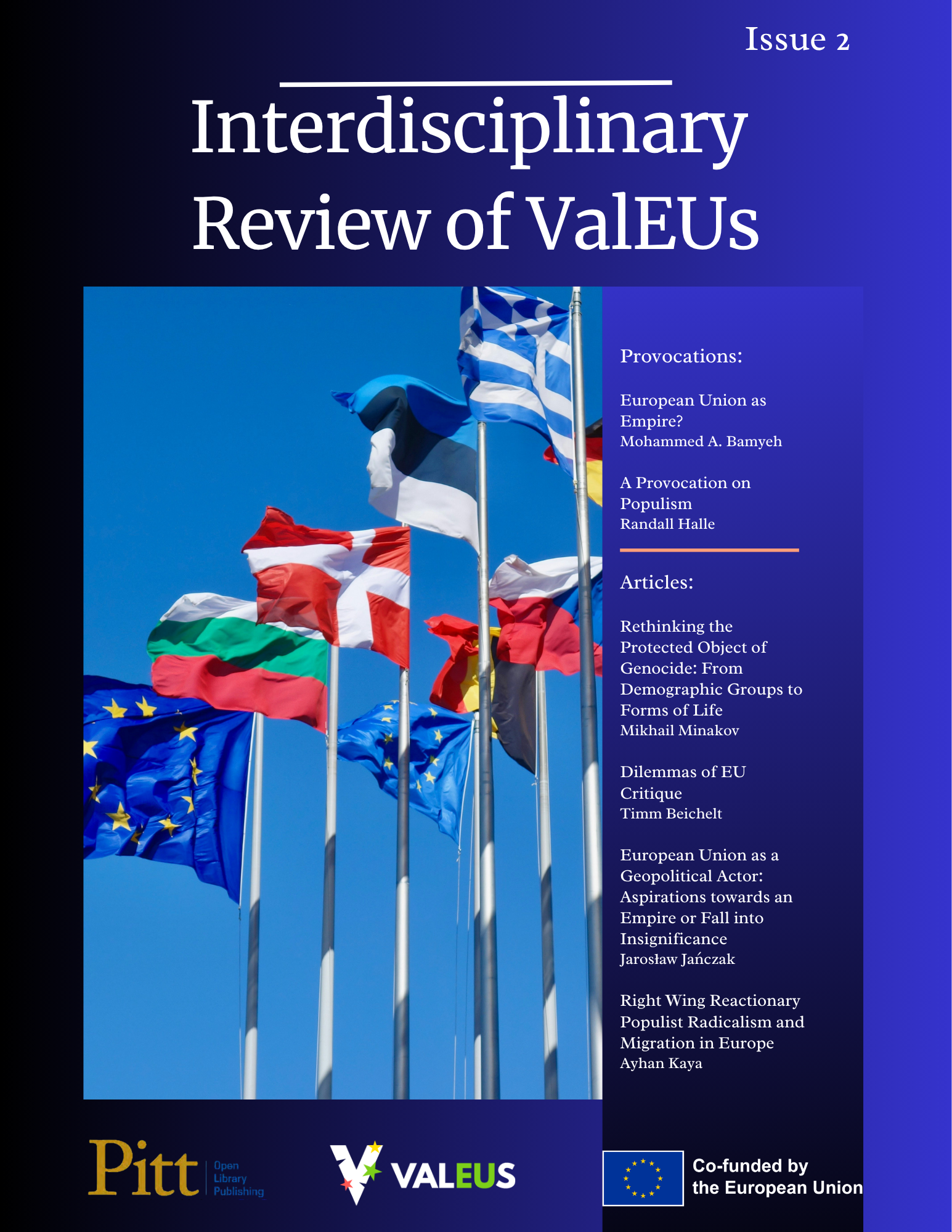
2026Issue 2 of the Interdisciplinary Review of ValEUs gathers work that range from provocation to essays with more extended modes of enquiry.
Two questions have structured the bulk of the network’s deliberations, and the issue is organized along the axis they describe. The first is directed outward, toward the European Union’s conduct in the world, and is fundamentally decolonial in orientation. What does it signify that a project assembled by former imperial powers narrates its own external conduct in the register of values rather than power, and what does that narration cost those situated on the far side of it? The second question turns inward, toward the Union’s constituent member states, and concerns the persistence of populism. Why does illiberalism continue to secure purchase within a polity whose founding self-description names liberal democracy as constitutive, and whose illiberalism is properly at issue when the charge is made?
Contributions by Mohammed Bamyeh, Jarosław Jańczak, and Mikhail Minakov take up the external question from the vantages of political theory, EU studies, and international law respectively, the last through a substantial archival reconstruction of the 1948 Genocide Convention’s drafting history. Timm Beichelt’s essay works across both axes, mapping the scholarly critique of the EU and distinguishing it from the harder Euroscepticism of populist politics. Dániel Mikecz, Ayhan Kaya, and Randall Halle address the internal question through frame analysis, fieldwork, and provocation in turn. Read together, the issue advances the claim that the Union’s difficulties abroad and at home are not separate phenomena but a single contradiction, differently articulated.
-
Issue 1
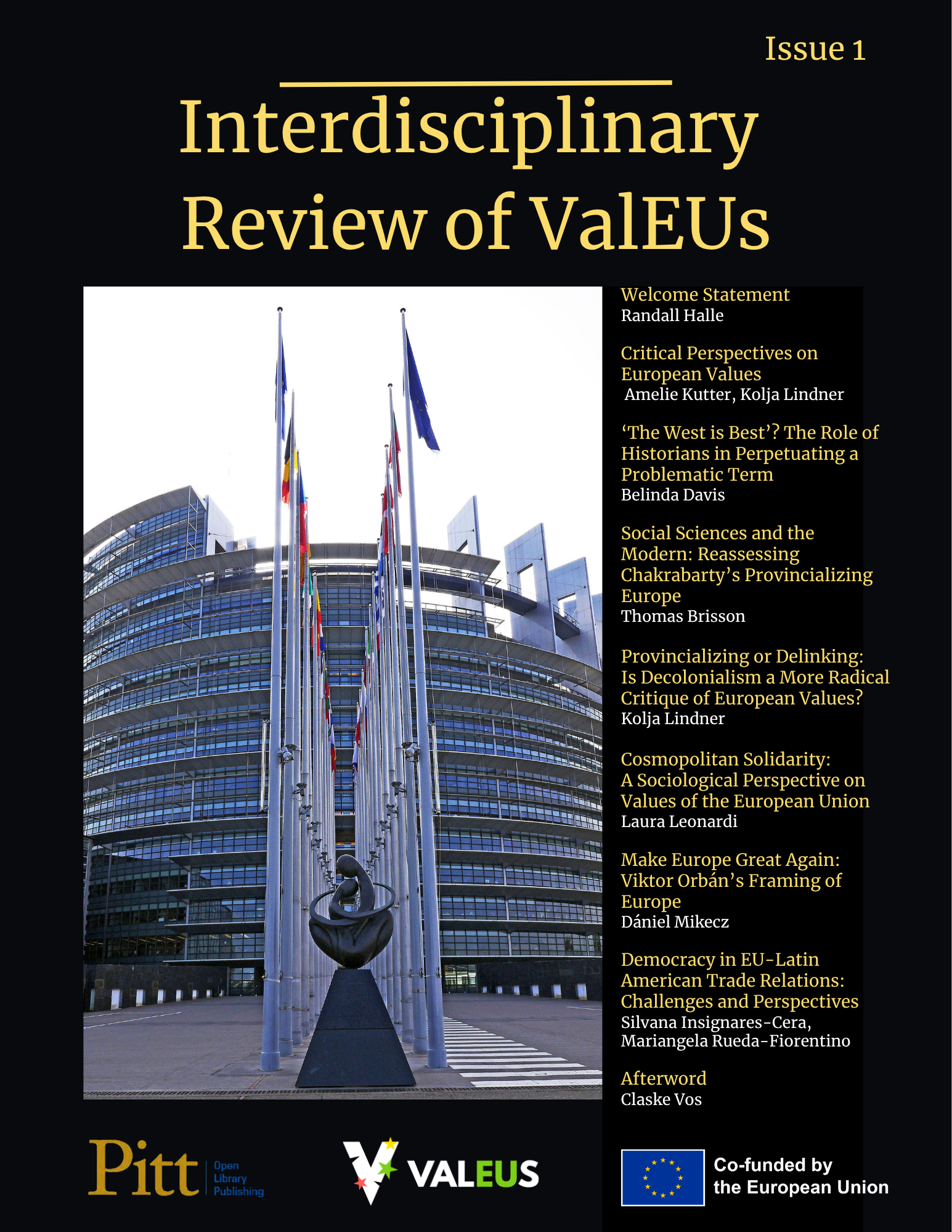
The inaugural issue of the Interdisciplinary Review of ValEUs critically examines the meaning and use of "European values" within the EU's normative and geopolitical landscape. Drawing on the first workshop of the Jean Monnet Policy Network ValEUs, held at University Paris 8 in June 2024, the collection brings together historians, political scientists, philosophers, and legal scholars to interrogate how values such as democracy, human dignity, freedom, and solidarity have been constructed, contested, and instrumentalized by the European Union.
Rather than simply cataloguing gaps between EU rhetoric and policy, contributors develop a mode of critique that is diagnostic, immanent, and prospective—identifying what needs questioning, applying transparent standards, and drawing out implications for both scholarship and politics. Essays range from a genealogy of "the West" as a contested concept, to postcolonial and decolonial readings of Eurocentrism, to grounded studies of migrant solidarity in southern Italy, populist reframings of Europe in Hungary, and the selective application of "democracy clauses" in EU–Latin American trade agreements.
Together, the contributions argue for a dynamic, constructionist understanding of European values that are continually reappropriated, renegotiated, and reinterpreted in specific local and geopolitical contexts. The issue opens with a welcome statement from the IRV editor Randall Halle framing the journal's mission, and closes with an afterword by Claske Vos synthesizing the workshop's key axes of inquiry.