
About the Journal
Interdisciplinary Review of ValEUs is an open-access, international interdisciplinary journal devoted to the study and teaching of the European Union and the role of EU foreign policy in global governance, past, present, and future. Established in 2024, this journal is the primary outlet of ValEUs: The Research and Education Network on Contestations to EU Foreign Policy, a Jean Monnet Network funded through the Erasmus+ Program of the European Commission and comprised of 20 higher education institutions from 17 countries and 5 continents. Editors in Chief are the members of the ValEUs Steering Committee.
Current Issue
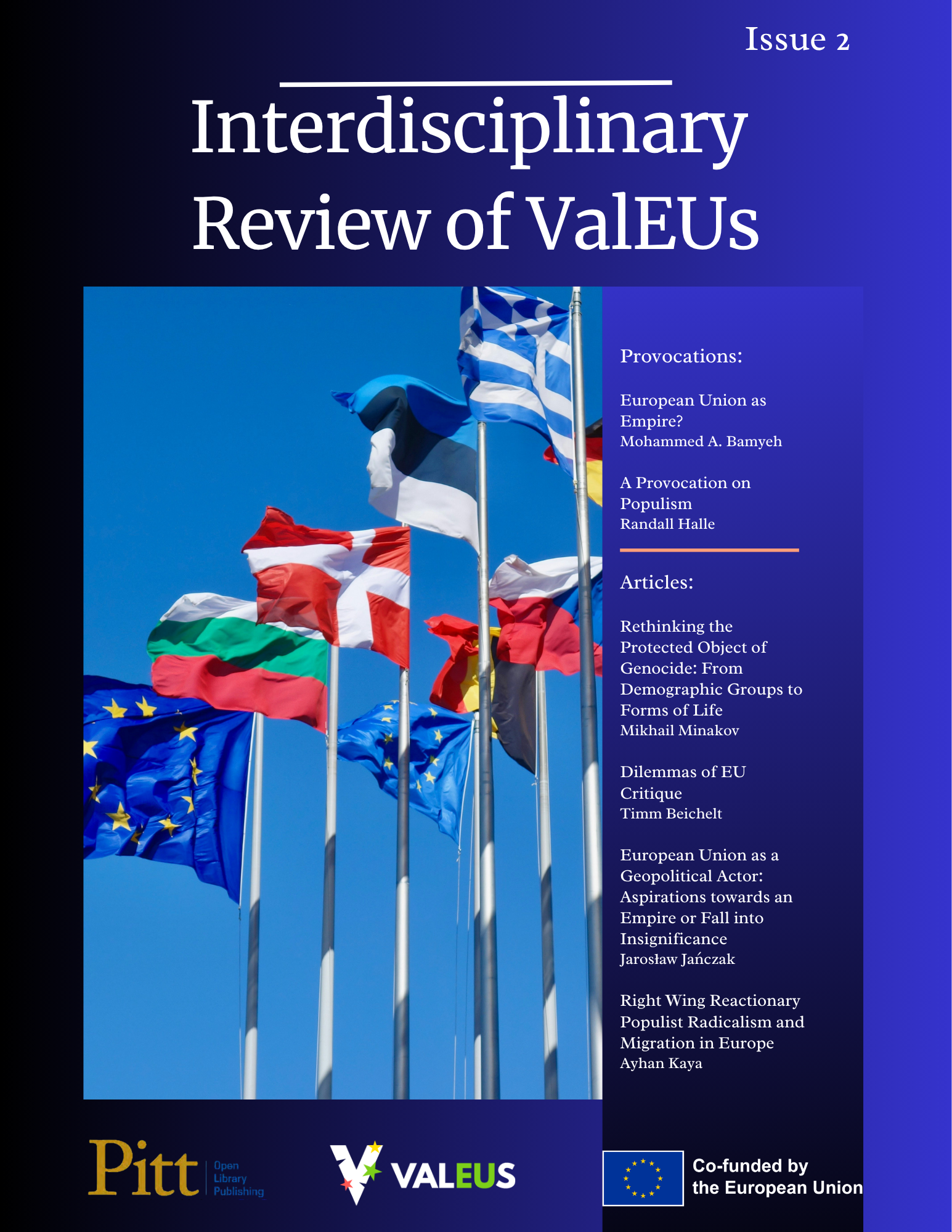
Issue 2 of the Interdisciplinary Review of ValEUs gathers work that range from provocation to essays with more extended modes of enquiry.
Two questions have structured the bulk of the network’s deliberations, and the issue is organized along the axis they describe. The first is directed outward, toward the European Union’s conduct in the world, and is fundamentally decolonial in orientation. What does it signify that a project assembled by former imperial powers narrates its own external conduct in the register of values rather than power, and what does that narration cost those situated on the far side of it? The second question turns inward, toward the Union’s constituent member states, and concerns the persistence of populism. Why does illiberalism continue to secure purchase within a polity whose founding self-description names liberal democracy as constitutive, and whose illiberalism is properly at issue when the charge is made?
Contributions by Mohammed Bamyeh, Jarosław Jańczak, and Mikhail Minakov take up the external question from the vantages of political theory, EU studies, and international law respectively, the last through a substantial archival reconstruction of the 1948 Genocide Convention’s drafting history. Timm Beichelt’s essay works across both axes, mapping the scholarly critique of the EU and distinguishing it from the harder Euroscepticism of populist politics. Dániel Mikecz, Ayhan Kaya, and Randall Halle address the internal question through frame analysis, fieldwork, and provocation in turn. Read together, the issue advances the claim that the Union’s difficulties abroad and at home are not separate phenomena but a single contradiction, differently articulated.